

Upon Inauguration In 1933 Apex
 | |
| Date | March four, 1933 (1933-03-04) |
|---|---|
| Location | U.s. Capitol, Washington, D.C. |
| Organized by | Joint Congressional Committee on Countdown Ceremonies |
| Participants | Franklin D. Roosevelt 32nd President of the U.s.a. — Bold office Charles Evans Hughes Chief Justice of the United States — Administering oath John Nance Garner 32nd Vice President of the United States — Bold office Charles Curtis 31st Vice President of the United states of america — Administering oath |
| | |
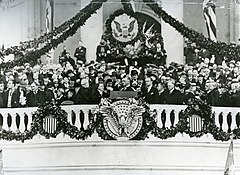
The kickoff inauguration of Franklin D. Roosevelt as the 32nd president of the Usa was held on Sat, March iv, 1933, at the East Portico of the United states of america Capitol in Washington, D.C. This was the 37th inauguration, and marked the commencement of the first term of Franklin D. Roosevelt equally president and John Nance Garner equally vice president.
It was also the concluding inauguration to be held on the constitutionally prescribed appointment of March iv, equally the 20th Amendment, ratified earlier that yr, moved Inauguration 24-hour interval to January xx. As a result, Roosevelt's (and Garner's) kickoff term in office was shorter than a normal term past 43 days. This was too the terminal time the vice president took the oath of office in the Senate chamber.
The inauguration took place in the wake of Democrat Roosevelt's landslide victory over Republican incumbent Herbert Hoover in the 1932 presidential election. With the nation at its superlative of the Great Depression, Roosevelt's inaugural speech was awaited with great anticipation. Broadcast nationwide on several radio networks, the speech was heard by tens of millions of Americans, and set the stage for Roosevelt's urgent efforts to answer to the crunch.[1]
Primary Justice Charles Evans Hughes administered the presidential oath of role. Roosevelt wore a morning coat and striped trousers for the inauguration, and took the oath with his mitt on his family Bible, open to I Corinthians 13. Published in 1686 in Dutch, it remains the oldest Bible e'er used in an inaugural ceremony, as well as the only 1 not in English language, and was originally used by Roosevelt for his 1929 and 1931 inaugurations as Governor of New York, and afterward his three subsequent presidential inaugurations until his death in 1945.[ii]
Inaugural speech [edit]
Roosevelt proceeded to deliver his 1,883-word, 20 infinitesimal-long inaugural address, all-time known for his famously pointed reference to "fear itself" (paraphrasing Thoreau)[3] in one of its kickoff lines (emphasis added):
And so, first of all, permit me assert my business firm belief that the just matter we have to fear is...fear itself — nameless, unreasoning, unjustified terror which paralyzes needed efforts to catechumen retreat into advance. In every dark hour of our national life, a leadership of frankness and of vigor has met with that understanding and back up of the people themselves which is essential to victory. And I am convinced that you volition again give that support to leadership in these disquisitional days.

Roosevelt used his First Inaugural Speech communication to outline his plan for the Bully Depression. This program was one he had referred to equally a 'new deal' when he accepted the Democratic Party nomination in 1932.[4] America, at the time that Roosevelt was inaugurated, was facing an unemployment rate of over twenty-five percent, which put more than than twelve 1000000 Americans out of work.[5] Roosevelt used his speech to highlight different parts of his proposed plan.
One office of Roosevelt'south programme was to find work for the American people. He stated, "Our greatest chief task is to put people to piece of work. This is no unsolvable problem if we face it wisely and courageously".[six] Roosevelt would later execute this plan by forming different programs such as the Civilian Conservation Corps (CCC) which provided jobs for 300,000 men and the Civil Works Administration (CWA) which provided work by creating "public work projects".[7]
Another part of Roosevelt'southward plan was to assist American farmers. Roosevelt stated, "The task can be helped by definite efforts to heighten the values of agricultural products and with this the ability to buy the output of our cities. It tin can be helped by preventing realistically the tragedy of the growing loss through foreclosure of our pocket-sized homes and our farms".[viii] To put this plan into activeness Roosevelt created the Agricultural Adjustment Human action (AAA) in May 1933. This program helped farmers by giving them incentives to cut production which increased the income of farmers. [nine]
The last chemical element that Roosevelt outlined in his speech was his plan for the depository financial institution crunch facing America during the Groovy Depression. He stated, "Finally, in our progress toward a resumption of work we require two safeguards against a return of the evils of the former gild: at that place must be a strict supervision of all cyberbanking and credits and investments so that there will be an finish to speculation with other people's money, and there must be provision for an adequate merely sound currency". [10] Roosevelt declared a banking holiday on March half-dozen, 1933, to stop the runs that were occurring on banks. During this time the banks were inspected to ensure that they would exist safe to concur coin when the banks reopened. Roosevelt created several programs to stabilize the United States banking arrangement, including the Glass-Steagall Act which guaranteed the savings of American citizens through the Federal Deposit Insurance Corporation and prevented commercial banks from engaging in investment cyberbanking [eleven]
Roosevelt, in his speech, attempted to convince the American people and Congress to follow his plan for the Great Depression. [12]
To do then he showtime compared the Not bad Depression to a war. Roosevelt stated, "It can be accomplished in part by direct recruiting by the Authorities itself, treating the task as we would treat the emergency of a war, but at the same time, through this employment, accomplishing greatly needed projects to stimulate and reorganize the use of our natural resources."[thirteen] This served to both impart on Americans how serious the situation was, but it too helped him justify his plan to Congress because wartime responsibilities fell to the President, non Congress. [14]
The second thing he did in his speech was to state that the Executive Branch may need to have heightened responsibilities, compared to the Legislative Co-operative, to face the crisis at manus. Roosevelt stated, "Information technology is to be hoped that the normal balance of executive and legislative authority may be wholly adequate to meet the unprecedented task earlier united states. Merely it may be that an unprecedented demand and demand for undelayed activity may call for temporary departure from that normal rest of public process" [15] This served to justify Roosevelt'south plan and the deportment that he may demand to take in order to accomplish that plan. [sixteen]
Addressing himself to the causes of the economic crisis and its moral dimensions, Roosevelt placed the blame squarely on the greed and shortsightedness of bankers and businessmen, every bit seen in the following excerpts:
...rulers of the exchange of flesh's goods accept failed through their own stubbornness and their own incompetence, take admitted their failure, and take abdicated. Practices of the unscrupulous money changers stand indicted in the courtroom of public stance, rejected by the hearts and minds of men.
The coin changers have fled from their high seats in the temple of our culture. We may now restore that temple to the aboriginal truths. The measure of the restoration lies in the extent to which we employ social values more noble than mere budgetary profit.
Recognition of the falsity of material wealth as the standard of success goes mitt in hand with the abandonment of the faux conventionalities that public function and high political position are to be valued just by the standards of pride of place and personal turn a profit; and there must be an finish to a comport in banking and in business which also often has given to a sacred trust the likeness of callous and selfish wrongdoing.
Restoration calls, however, not for changes in ethics solitary. This Nation is asking for activity, and action now.

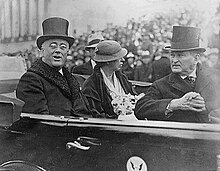
Hoover and Roosevelt on Inauguration Twenty-four hour period, 1933.
Roosevelt then turned, in the following excerpts, to the daunting issue of unemployment, which had reached a staggering 25 percent when he assumed part:
...the withered leaves of industrial enterprise lie on every side; farmers find no markets for their produce; the savings of many years in thousands of families are gone.
More important, a host of unemployed citizens face the grim problem of existence, and an every bit dandy number toil with footling return. Only a foolish optimist can deny the night realities of the moment.
Our greatest primary chore is to put people to piece of work. This is no unsolvable problem if we face it wisely and courageously.
There are many ways in which it can be helped, but it can never be helped merely by talking about information technology. We must act and act rapidly.
After touching briefly on strange relations — "the policy of the good neighbor — the neighbour who resolutely respects himself and, because he does so, respects the rights of others" — Roosevelt turned again to the economical crisis, assuring his countrymen that he would act swiftly and with determination:
I am prepared nether my constitutional duty to recommend the measures that a stricken Nation in the midst of a stricken globe may require. These measures, or such other measures as the Congress may build out of its experience and wisdom, I shall seek, within my ramble potency, to bring to speedy adoption. But in the event that the Congress shall fail to have one of these ii courses, and in the event that the national emergency is all the same disquisitional, I shall non evade the clear course of duty that will and then confront me. I shall ask the Congress for the one remaining instrument to meet the crisis — broad Executive power to wage a war confronting the emergency, as groovy as the power that would be given to me if nosotros were in fact invaded by a strange foe.
Rhetorical aspects [edit]
Roosevelt fabricated several very important rhetorical choices in his First Inauguration Speech. He understood that the plan that he was proposing appeared would seem very radical to the American people who were not used to such action exterior of wartime.[17] To convince the American people of his plan he outlined how dire the situation was, reassured them that his plan was necessary, and appealed to their sense of patriotism.
The first thing that Roosevelt attempted to practise was convince the American people that the situation was extremely dire and needed immediate activeness. He said, "Values have shrunken to fantastic levels; taxes accept risen; our ability to pay has fallen; authorities of all kinds is faced by serious curtailment of income; the means of exchange are frozen in the currents of trade; the withered leaves of industrial enterprise lie on every side; farmers find no markets for their produce; the savings of many years in thousands of families are gone". [18] America was facing the worst depression in history; Roosevelt outlined the problems facing the land so that the American people would understand his need to take action. [19]
The second thing that Roosevelt did to convince the American people was to justify his need to have on more control to implement his plan. Roosevelt said, "I shall enquire the Congress for the one remaining instrument to come across the crisis—broad Executive power to wage a war confronting the emergency, equally great as the power that would be given to me if we were in fact invaded past a foreign foe". [20] By comparing the Bully Low to a war and stating that the only solution to this situation was to requite the Executive Branch the ability to fight this 'state of war', Roosevelt hoped to convince American'southward that he needed more ability to execute his programme. [21]
The final matter that Roosevelt did was appeal to the patriotism of the American people. He said "We do not distrust the future of essential commonwealth. The people of the United States take non failed. In their need, they have registered a mandate that they desire direct, vigorous activity. They have asked for discipline and management nether leadership". [22] Roosevelt hoped to use the thought of patriotism to convince the American people, that despite their distrust for sweeping government action, the steps he planned to take were necessary for America. [23]
After the inaugural address, a adult female by the name Sarah Dear said "Whatsoever human being who tin can talk like that in times like these is worthy of every ounce of support a true American has."[24] Love's quote is cogitating of the popular sentiment felt for Roosevelt's dynamic, confident, and inspiring oratory.
Close aide Raymond Moley was responsible for crafting the speech communication, as he did many of Roosevelt's speeches.[24] The idea of likening Roosevelt's coming job to commanding a war effort originated from Moley.[25]
Countdown ball [edit]
Roosevelt's married woman Eleanor wore a calorie-free blueish clothes designed by Sally Milgrim to the countdown ball. The clothes was later displayed at the Smithsonian Establishment.[26] [27]
Aftermath [edit]
The solar day after his inauguration, Roosevelt assembled a special session of Congress to declare a iv-twenty-four hours banking company holiday, and on March ix signed the Emergency Cyberbanking Human action, which provided a mechanism for reopening. He connected on for what became his First Hundred Days of the New Deal.
Meet also [edit]
- Causes of the Bang-up Depression
- Great Contraction
- Presidency of Franklin D. Roosevelt
- Second inauguration of Franklin D. Roosevelt
- Third inauguration of Franklin D. Roosevelt
- Fourth inauguration of Franklin D. Roosevelt
- 1932 United States presidential election
References [edit]
- ^ "Radio as the Significant Context of FDR's Rhetoric" Archived 2005-08-17 at the Wayback Car
- ^ "The 37th Presidential Inauguration: Franklin D. Roosevelt, March 04, 1933". United States Senate. Retrieved July v, 2021.
- ^ "Thoreau & FDR | The Thoreau Social club". world wide web.thoreausociety.org . Retrieved 2020-08-08 .
- ^ "Franklin D. Roosevelt." The White House. The United States Government, January 15, 2021. https://world wide web.whitehouse.gov/virtually-the-white-house/presidents/franklin-d-roosevelt/. "Great Low Facts." FDR Presidential Library & Museum, https://www.fdrlibrary.org/dandy-depression-facts.
- ^ Leuchtenburg, William Due east. "Franklin D. Roosevelt: Domestic Affairs." Miller Center. The University of Virginia, July 24, 2018. https://millercenter.org/president/fdroosevelt/domestic-affairs.
- ^ Roosevelt, F. D. Franklin D. Roosevelt Countdown Address. The American Presidency Projection. March 1933. https://www.presidency.ucsb.edu/documents/countdown-accost-eight.
- ^ Leuchtenburg, William E. "Franklin D. Roosevelt: Domestic Affairs." Miller Center. The Academy of Virginia, July 24, 2018. https://millercenter.org/president/fdroosevelt/domestic-diplomacy.
- ^ Roosevelt, F. D. Franklin D. Roosevelt Countdown Address. The American Presidency Projection. March 1933. https://www.presidency.ucsb.edu/documents/inaugural-address-8.
- ^ Leuchtenburg, William E. "Franklin D. Roosevelt: Domestic Affairs." Miller Centre. The Academy of Virginia, July 24, 2018. https://millercenter.org/president/fdroosevelt/domestic-diplomacy.
- ^ Roosevelt, F. D. Franklin D. Roosevelt Inaugural Accost. The American Presidency Project. March 1933. https://www.presidency.ucsb.edu/documents/inaugural-accost-8.
- ^ Leuchtenburg, William E. "Franklin D. Roosevelt: Domestic Affairs." Miller Center. The University of Virginia, July 24, 2018. https://millercenter.org/president/fdroosevelt/domestic-affairs.
- ^ "FDR's First Inaugural Address Declaring 'War' on the Great Depression." National Athenaeum and Records Administration. National Athenaeum and Records Administration. Accessed February 25, 2021. https://world wide web.archives.gov/education/lessons/fdr-inaugural.
- ^ Roosevelt, F. D. Franklin D. Roosevelt Inaugural Address. The American Presidency Project. March 1933. https://www.presidency.ucsb.edu/documents/inaugural-address-8.
- ^ "FDR's First Inaugural Address Declaring 'State of war' on the Cracking Depression." National Archives and Records Assistants. National Athenaeum and Records Administration. Accessed February 25, 2021. https://www.archives.gov/pedagogy/lessons/fdr-inaugural.
- ^ Roosevelt, F. D. Franklin D. Roosevelt Inaugural Address. The American Presidency Projection. March 1933. https://www.presidency.ucsb.edu/documents/inaugural-accost-viii.
- ^ "FDR's Offset Inaugural Address Declaring 'War' on the Swell Depression." National Archives and Records Administration. National Archives and Records Administration. Accessed Feb 25, 2021. https://www.archives.gov/education/lessons/fdr-inaugural.
- ^ "FDR's Get-go Inaugural Accost Declaring 'War' on the Great Depression." National Athenaeum and Records Administration. National Archives and Records Assistants. Accessed February 25, 2021. https://world wide web.archives.gov/education/lessons/fdr-inaugural.
- ^ Roosevelt, F. D. Franklin D. Roosevelt Countdown Address. The American Presidency Projection. March 1933. https://www.presidency.ucsb.edu/documents/inaugural-address-8.
- ^ Leuchtenburg, William E. "Franklin D. Roosevelt: Domestic Diplomacy." Miller Center. The University of Virginia, July 24, 2018. https://millercenter.org/president/fdroosevelt/domestic-affairs.
- ^ Roosevelt, F. D. Franklin D. Roosevelt Inaugural Accost. The American Presidency Projection. March 1933. https://world wide web.presidency.ucsb.edu/documents/inaugural-address-viii.
- ^ "FDR'southward First Inaugural Address Declaring 'War' on the Great Depression." National Athenaeum and Records Assistants. National Athenaeum and Records Assistants. Accessed February 25, 2021. https://www.archives.gov/didactics/lessons/fdr-countdown.
- ^ Roosevelt, F. D. Franklin D. Roosevelt Inaugural Accost. The American Presidency Projection. March 1933. https://www.presidency.ucsb.edu/documents/inaugural-address-8.
- ^ "FDR's Commencement Countdown Address Declaring 'State of war' on the Great Depression." National Athenaeum and Records Assistants. National Archives and Records Assistants. Accessed February 25, 2021. https://world wide web.athenaeum.gov/education/lessons/fdr-inaugural.
- ^ a b Houck, Davis (2002). FDR and Fear Itself: The Beginning Countdown Address . Higher Station: Texas A&M University Printing. ISBN1585449865.
- ^ "Teaching With Documents: FDR's Outset Inaugural Accost". National Archives . Retrieved 20 Oct 2013.
- ^ Neuman, Johanna (September 29, 2014). "From Ghetto to Glamour". momentmag.com . Retrieved November 13, 2019.
- ^ "Smithsonian's "Beginning Ladies" drove". cbsnews.com . Retrieved November 13, 2019.
Farther reading [edit]
- Houck, Davis W. & Nocasian, Mihaela. "FDR'due south Kickoff Inaugural Address: Text, Context, and Reception". Rhetoric and Public Affairs. 5 (4): 649–678. eISSN 1534-5238. ISSN 1094-8392. JSTOR 41940292.
External links [edit]
- More than documents from the Library of Congress
- Newsreel footage of Roosevelt'due south 1933 inauguration from C-Bridge (via YouTube)
- Text of Roosevelt's First Inaugural Accost
- Audio of Roosevelt'southward Beginning Countdown Accost (via YouTube)

Upon Inauguration In 1933 Apex,
Source: https://en.wikipedia.org/wiki/First_inauguration_of_Franklin_D._Roosevelt
Posted by: staufferlontoll.blogspot.com
0 Response to "Upon Inauguration In 1933 Apex"
Post a Comment